
Accounting and Finance Resume Writing: Tips, Examples, and a Final Checklist
Write a stronger accounting or finance resume with role-specific keywords, achievement examples, clear formatting, and a practical application checklist.
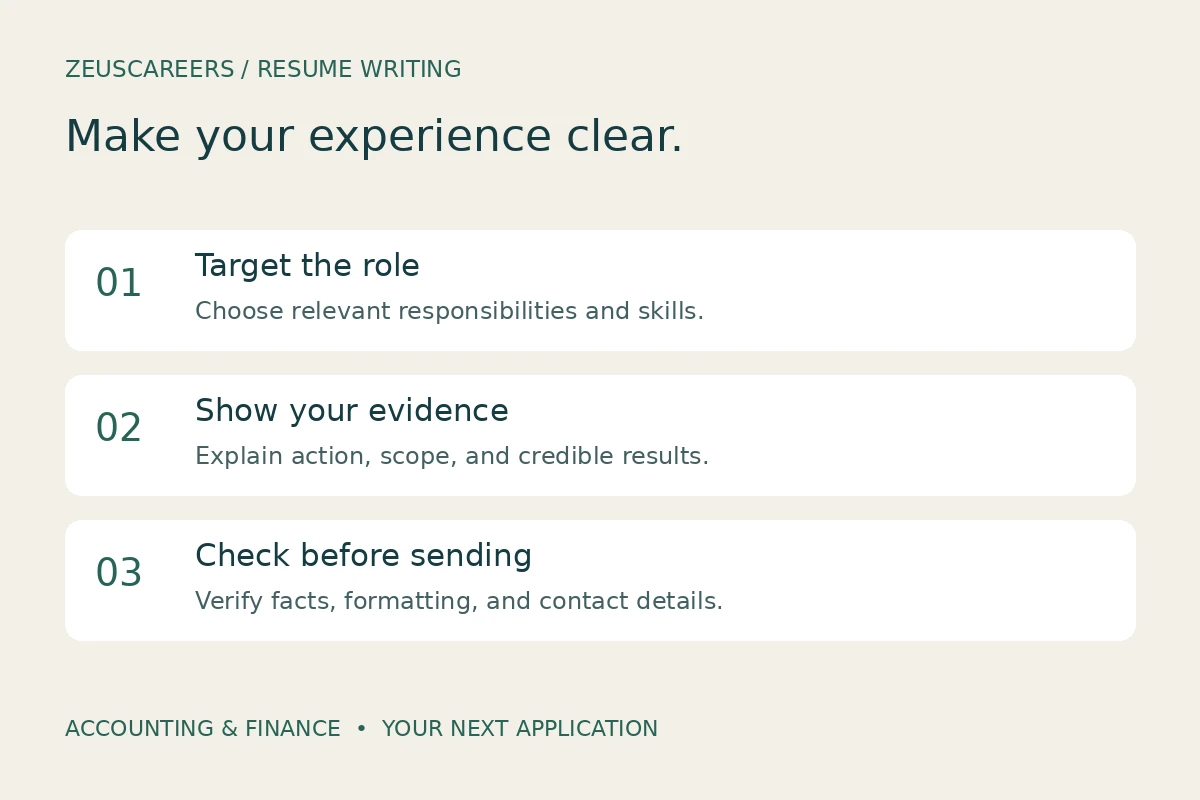
In this article
- 1. Start with the job description
- 2. Write a summary with a clear target
- 3. Turn duties into evidence
- 4. Choose keywords that match your actual work
- 5. Make the document easy to read and submit
- 6. Present education and credentials accurately
- 7. Adjust the emphasis to your career stage
- 8. Run a final resume checklist
- Frequently asked questions about finance resumes
- Get help with your next application
A strong accounting or finance resume helps an employer understand three things quickly: the work you can own, the systems you can use, and the evidence behind your experience. A long list of duties rarely answers those questions as clearly as a few specific examples.
Use these resume writing tips to prepare an application for staff accountant, financial analyst, payroll, accounts payable, controller, or related roles. Keep a detailed master resume, then tailor a copy to each opportunity on the ZeusCareers accounting and finance job board.
1. Start with the job description
Before editing your resume, identify the employer's main responsibilities, required qualifications, and preferred systems. For an accountant, those might include reconciliations, journal entries, and month-end close. An FP&A opening may emphasize forecasting, variance analysis, and working with department leaders.
Choose the requirements you can support with real experience. Use the employer's terminology where it accurately describes your work. Do not copy a posting wholesale or add a credential, system, or responsibility you cannot explain in an interview.
2. Write a summary with a clear target
A short summary can connect your experience to the role. Replace vague language such as “results-driven professional seeking a challenging opportunity” with your level, relevant responsibilities, and technical strengths.
Example for a candidate with matching experience: “Staff accountant with experience preparing journal entries, reconciling balance-sheet accounts, and supporting monthly close. Uses Excel pivot tables and lookups to investigate account differences and organize supporting schedules.”
An early-career candidate can describe relevant coursework, an internship, or a clearly labeled academic project. Someone changing careers should explain transferable work such as investigating billing discrepancies or maintaining accurate transaction records, without implying accounting responsibilities they have not held.
3. Turn duties into evidence
A useful bullet combines an action, the work's scope, and an outcome or purpose. Numbers help when they are accurate, but a credible explanation is better than an invented percentage.
- Vague: “Responsible for reconciliations.” More specific: “Prepared monthly balance-sheet reconciliations, investigated aging reconciling items, and documented adjustments for review.”
- Vague: “Helped with financial reports.” More specific: “Prepared monthly budget-to-actual reports and summarized expense movements for department managers.”
- Vague: “Handled invoices.” More specific: “Matched supplier invoices to purchase orders and receiving records, escalating quantity and pricing discrepancies before payment.”
If you can verify volume, timing, or scope, add it. A template is: “Reconciled [number] accounts across [number] entities each month and resolved [type of discrepancy] before close.” Replace every bracket with truthful details or remove it. These examples are writing models, not claims to paste into your own history.
For additional approaches, read our accountant resume achievement examples.
4. Choose keywords that match your actual work
Recruiters may search for job titles, responsibilities, and systems. Include relevant terms naturally in a skills section and in experience bullets that show how you used them.
- Staff and senior accounting: general ledger, account reconciliations, journal entries, financial reporting, month-end close.
- Financial analysis and FP&A: budgeting, forecasting, variance analysis, financial modeling, management reporting.
- Accounts payable and receivable: invoice processing, purchase-order matching, collections, cash application, aging reports.
- Payroll: payroll processing, payroll reconciliations, timekeeping, and the systems you have used.
- Controller and accounting leadership: close ownership, internal controls, audit coordination, team development, and systems improvements.
Only include terms that fit your background and the opening. If you have used a system in coursework rather than employment, label that context. Avoid hiding keywords or repeating them in a way that makes the document harder to read.
5. Make the document easy to read and submit
Use a simple layout, clear headings, consistent dates, and readable text. “Professional Experience,” “Education,” “Skills,” and “Certifications” are straightforward labels. A single-column layout reduces the reading-order problems that complex tables and sidebars can introduce when application systems extract text.
Follow the employer's requested file type. If both PDF and Word are accepted, use a clean version and check the uploaded preview. Confirm that the text can be selected and copied in the correct order; avoid submitting a scanned image of your resume.
Keep essential contact information in the main document body. Use a professional email address and a current phone number. City and state are generally enough location detail for an initial resume unless the application requests more.
6. Present education and credentials accurately
List your degree, institution, and relevant qualifications using their correct names. Distinguish completed credentials from study in progress. Do not use CPA after your name unless you hold the applicable credential; describe exam progress accurately and separately.
For recent graduates, relevant coursework and projects can help demonstrate preparation. For experienced candidates, give more space to recent work and responsibilities that match the target role. Read our CPA versus CMA guide for a broader discussion of credential paths.
7. Adjust the emphasis to your career stage
Early career: highlight internships, relevant projects, accounting fundamentals, and systems exposure. Explain your contribution instead of listing a course title alone.
Experienced individual contributor: show ownership of accounts, reports, forecasts, or processes. Explain the complexity of the work and how you investigate issues.
Manager or controller: include team scope, review responsibilities, controls, close leadership, and collaboration with operations. Attribute team achievements fairly and explain your own contribution.
Aim for enough space to show relevant evidence without repetition. One page may suit an early-career candidate; two may be useful for a substantial relevant work history. Length alone does not make a resume effective.
8. Run a final resume checklist
- Does the top third clearly match the role you want?
- Can you explain every skill and achievement in an interview?
- Are job titles, employer names, dates, and credential details accurate?
- Do recent roles show specific responsibilities and evidence?
- Have you removed confidential client information and unsupported figures?
- Do contact details and any portfolio or profile links work?
- Does the uploaded file display correctly, with no comments or tracked changes?
- Have you saved a copy of the resume and job description for interview preparation?
Frequently asked questions about finance resumes
Should I use the same resume for every accounting job?
Keep your underlying work history consistent, but adjust the summary, skill emphasis, and order of relevant bullets to each posting. A payroll role and a financial analyst role require different evidence.
What if I do not have measurable achievements?
Describe scope, frequency, complexity, and purpose. The accounts you reconciled, reporting cycle you supported, or discrepancies you investigated can communicate value without an invented result.
Can a resume template guarantee an interview?
No. Clear formatting and relevant evidence help employers assess your application, but outcomes also depend on qualifications, the opening, and the hiring process.
Get help with your next application
Explore ZeusCareers resume writing services for help presenting your accounting and finance experience. Then browse accounting and finance opportunities and use the candidate resource hub to prepare for your next step. Our finance resume guide offers a shorter overview to revisit before submitting.
Put your next move into action.
Explore accounting and finance opportunities, strengthen your resume, or find practical hiring tools.