
Can AI Handle Month-End Close? Try the Missing Invoice Challenge
Test AI on a fictional month-end close. Find the missing invoice, check the reconciliation, and practice explaining the issue in an accounting interview.
In this article
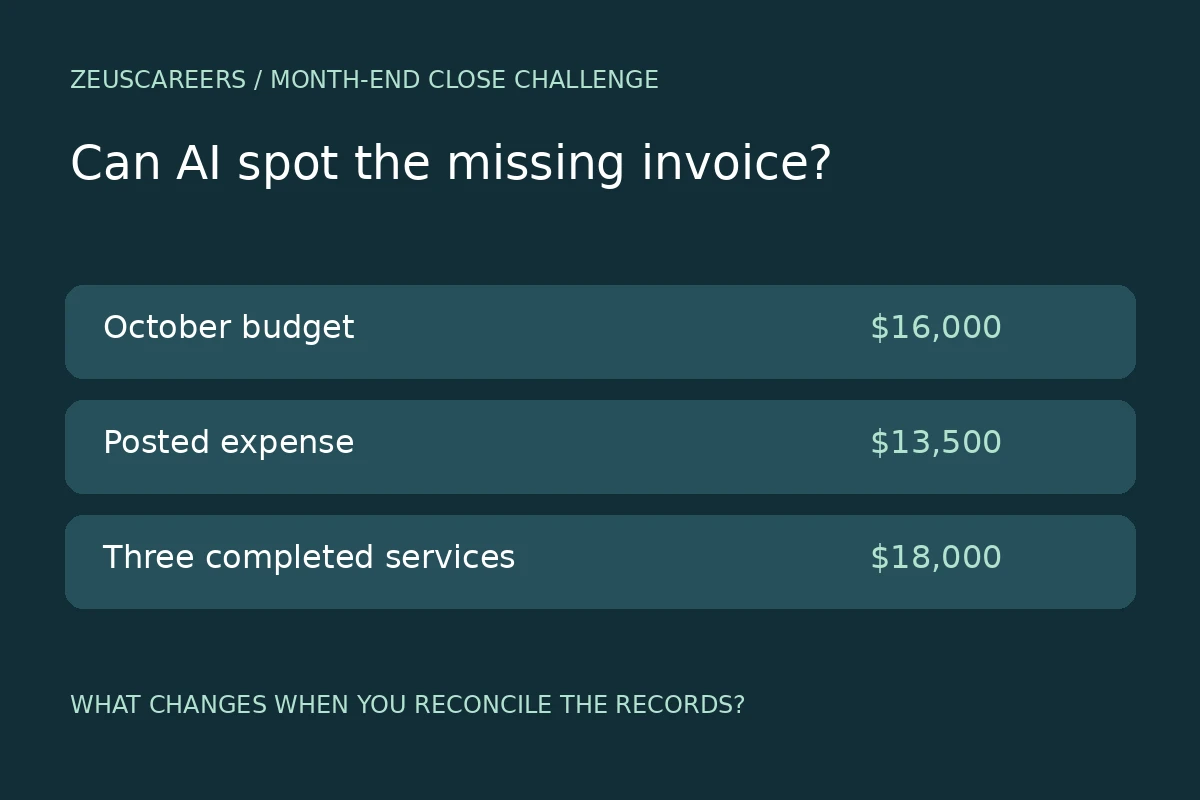
Three vendor charges add up to $18,000. The ledger shows $13,500. A polished AI summary says the department came in under budget. Before you forward it, can you spot the problem?
Try this five-minute month-end close challenge. Work through the numbers yourself, then give the same fictional records to an approved AI tool and compare its answer with yours.
The missing invoice challenge
You are reviewing October outside services for a fictional company. The approved budget is $16,000. All three services below were completed in October. Assume the amounts are accurate and the company records expenses for services in the period they are received. The ledger extract is complete for the account and period shown.
- Northline design, $8,000. Invoice posted in October.
- Westfield maintenance, $5,500. Invoice posted in October.
- Riverside testing, $4,500. Work accepted October 30. The invoice arrived November 3 and did not appear in the October ledger.
What expense is missing? How does resolving it change the budget variance? What evidence would you attach before sending the result for review?
Copy this prompt and compare answers
Review this fictional October close. Budget is $16,000. The October ledger contains design of $8,000 and maintenance of $5,500. Testing of $4,500 was completed and accepted October 30, and its invoice arrived November 3. Assume the amounts are accurate and expenses are recorded in the period services are received. Show posted expense, the missing amount, expected October expense after review, and the variance against budget before and after the adjustment. Separate supplied facts from recommended checks. List the evidence a reviewer would need.
Give the tool only these sample facts. For workplace use, follow your employer’s rules on approved tools and permitted data. Keep confidential invoices, customer records, and financial extracts out of tools that are unauthorized for those inputs.
The answer and what to check in the AI output
The posted expense is $13,500, or $2,500 below budget. The $4,500 testing charge is the missing October expense in this exercise. Including it brings expected October expense to $18,000, which is $2,000 above budget. The adjustment changes the direction of the variance.
A reviewer would want the acceptance record, the supplier invoice or other support for the amount, and evidence that the charge had not already been recorded elsewhere. Before proposing an entry in a real close, check the account, entity, period, and company approval process. Coordinate how the later invoice will be handled to avoid recording the expense twice.
Score the response using three checks. Did it use the supplied October acceptance date? Did it calculate both variances correctly and label their direction? Did it distinguish what the records show from what still needs to be verified? A plausible explanation deserves the same review as a rough one.
Where AI can help during month-end close
Use an approved tool to draft an exception checklist, organize questions for a cost owner, or turn a verified reconciliation into plain language. Review the output against the source records and document who reviewed any proposed adjustment. The U.S. Bureau of Labor Statistics describes automation as a way for accountants and auditors to spend more time on analysis and higher-level responsibilities. BLS occupational outlook for accountants and auditors
How to discuss the exercise in an accounting interview
Try explaining the result in three sentences. “I compared the October ledger to the evidence that services had been delivered. I identified a $4,500 timing difference that moved the account from $2,500 below budget to $2,000 above. I would document the acceptance date, verify that the expense was missing, and send the proposed adjustment through review.” Identify the example as a practice case when discussing it with a hiring manager.
For a second round, change the testing acceptance date to November 2 and state explicitly that no testing services were delivered in October. See whether the tool changes its answer and explains which fact changed the conclusion.
Practice more questions with the month-end close interview guide, explore the AI skills guide for accounting and finance, or browse staff accountant jobs on ZeusCareers.
Put your next move into action.
Explore accounting and finance opportunities, strengthen your resume, or find practical hiring tools.