
Cost Accountant Careers: Manufacturing Skills, Duties, and Job Search Tips
Explore cost accountant careers in manufacturing: standard costs, inventory, variance analysis, essential skills, interview preparation, and job search tips.
In this article
Why can a factory sell more products and still miss its profit target? Materials may cost more than planned, production may use extra labor, or scrap may consume inventory. Cost accountants help connect those operating changes to financial results.
If you enjoy accounting and want to understand how a business makes its products, manufacturing cost accounting is a career path to explore. This guide explains the work, the concepts behind it, and how to prepare for cost accountant jobs.
What does a cost accountant do?
A cost accountant analyzes the costs of producing goods or delivering services. In manufacturing, responsibilities may include product costing, inventory reconciliation, production-cost reporting, and explaining differences between planned and actual results. The exact scope depends on the company, its systems, and the role's seniority.
The U.S. Bureau of Labor Statistics places cost accounting within the broader management accounting field. Unlike a role focused mainly on external reporting, this work often supports internal operating decisions.
Five manufacturing accounting concepts to understand
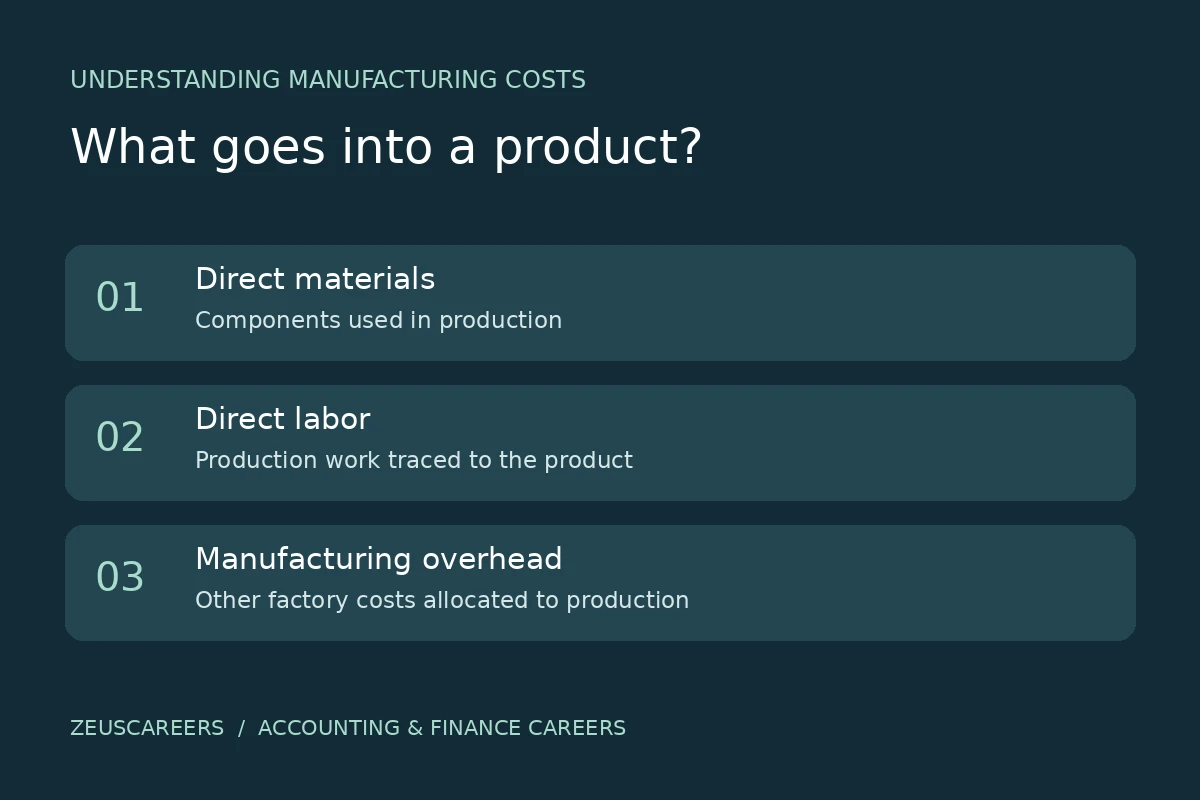
1. Direct materials, direct labor, and manufacturing overhead
Direct materials become part of the product. Direct labor is production work traceable to that product. Manufacturing overhead includes other factory costs, such as factory utilities or equipment depreciation, that must be assigned using an appropriate method. Understanding how a company classifies and allocates costs is more useful than memorizing a single spreadsheet template.
2. Standard costing
A standard cost is a planned benchmark for producing an item under defined assumptions. It may reflect expected material quantities, purchase prices, labor time, and overhead rates. Standards need an owner and a review process: an outdated bill of materials or production routing can distort the comparison with actual results.
3. Variance analysis
A variance is a difference between a benchmark and an actual result. A useful analysis separates possible causes, then checks the underlying transactions. A higher material cost may reflect a price increase, greater consumption, a product-mix change, or a recording issue. Calling a variance unfavorable does not explain why it happened.
4. Inventory and work in process
Manufacturers may hold raw materials, partly completed goods called work in process, and finished goods. Cost accountants help reconcile inventory records with the general ledger, review adjustments, and investigate discrepancies. Physical counts, cycle counts, production cutoffs, and timely transaction entry all affect the reliability of the numbers.
5. Bills of materials and production routings
A bill of materials identifies the components needed for a product. A routing describes production steps and their associated resources or time. A cost accountant needs to understand how these records feed the costing system and who approves changes. Collaboration with engineering, purchasing, and operations is part of maintaining useful financial information.
A simple cost variance example
Suppose a fictional manufacturer plans to use 2 kilograms of material per unit at $5 per kilogram. For 1,000 units, the standard material cost is $10,000. Actual production uses 2,100 kilograms purchased and consumed at $5.20 per kilogram, for a cost of $10,920.
- Total difference: $10,920 minus $10,000 equals $920 unfavorable.
- Price component: 2,100 kilograms × ($5.20 − $5.00) equals $420 unfavorable.
- Usage component: (2,100 − 2,000) kilograms × $5.00 equals $500 unfavorable.
The two components reconcile to $920. This simplified example assumes the same material and that all purchased material is consumed in the period. It excludes labor and overhead. In practice, the accountant would investigate purchase records, scrap, quality issues, substitutions, and transaction accuracy before recommending action.
Skills to demonstrate when applying
- Accounting fundamentals: explain reconciliations, journal entries, inventory accounts, and your role in month-end close.
- Spreadsheet analysis: show how you validate source data, use lookups or pivot tables, and check that a report reconciles.
- ERP familiarity: describe systems you have actually used and the transactions or reports you worked with.
- Operational curiosity: explain how you would learn a production process and ask questions on the factory floor.
- Communication: translate a cost movement into a clear explanation, supported by evidence and an appropriate next step.
Use accurate resume examples: “Reconciled monthly inventory balances across two locations” is more informative than “Responsible for cost accounting.” Add results only when you can substantiate them. See our accountant resume achievement examples for more guidance.
How to move into cost accounting
A staff accountant may build relevant experience through inventory reconciliations and close support. An accounts payable professional may bring knowledge of purchasing and invoice discrepancies, while an analyst may bring reporting skills. These are starting points; each candidate still needs to address the accounting and manufacturing knowledge required by the employer.
Practice with a small fictional production dataset. Build a standard-cost calculation, compare actual consumption, reconcile the difference, and write a short explanation for a plant manager. Label it as a practice project when discussing it in an application.
Search titles such as cost accountant, manufacturing accountant, inventory accountant, plant accountant, and senior cost accountant. Compare duties carefully: similar titles can carry different responsibilities. Broaden your search with our accounting and finance job search guide.
Questions to ask in a cost accountant interview
- Does the business use standard costing, actual costing, job costing, or a combination?
- Who maintains bills of materials, routings, and overhead assumptions?
- How are inventory discrepancies investigated and resolved?
- What are the close deadlines and the most common reporting challenges?
- How often does the finance team work directly with production leaders?
- What would successful performance look like in the first 90 days?
For employers, these same topics help define a realistic job description. Specify the manufacturing environment, systems, costing responsibilities, reporting line, and required experience before you post a job free on ZeusCareers.
Frequently asked questions
Do cost accountant jobs require a CPA?
Requirements vary by employer. Some postings require or prefer a credential; others emphasize relevant education and practical experience. Read each listing and distinguish mandatory qualifications from preferences. Explore our CPA versus CMA guide when considering credentials.
Is cost accounting the same as financial analysis?
The roles overlap in reporting and explaining results. Cost accounting typically focuses on how costs are recorded, assigned, reconciled, and interpreted. Financial analysis may cover broader forecasts, budgets, or commercial decisions. A job description is the best guide to the actual scope.
Can cost accountants become controllers?
Cost accounting can build useful operational finance experience. Moving toward a controller role usually requires broader responsibility for reporting, controls, close processes, and team leadership. Progression depends on experience and the employer's needs.
Find your next accounting opportunity
Start with cost accountant opportunities on ZeusCareers, or broaden your search to manufacturing accountant roles. Verify availability and requirements on each employer's application page. Visit our candidate resource hub for more preparation tools.
Put your next move into action.
Explore accounting and finance opportunities, strengthen your resume, or find practical hiring tools.