
How to Hire Accounting and Finance Candidates Who Align With Your Core Values
Attract accounting and finance candidates who share your core values and meet role standards with clear job posts, structured interviews, and a hiring scorecard.
In this article
- 1. Turn core values into job-related behaviors
- 2. Define the professional standards for the specific role
- 3. Write a job posting that shows your values in practice
- 4. Attract candidates through a clear employer story
- 5. Use structured interview questions
- 6. Assess technical skills with a relevant work sample
- 7. Compare evidence with a hiring scorecard
- 8. Let candidates assess your culture too
- Frequently asked questions
- Build a stronger accounting and finance hiring process
Finding accounting and finance candidates who align with your company culture starts with a clear definition of how your team works. “Great culture fit” is difficult to assess on its own. Integrity when a report contains an error, accountability during close, and respectful communication with operations are behaviors you can discuss and evaluate.
For employers hiring accountants, financial analysts, payroll specialists, or finance leaders, the goal is to attract people who can meet the role's technical requirements and support the values your business practices. This guide offers a practical process, from writing the job posting to comparing interview evidence.
1. Turn core values into job-related behaviors
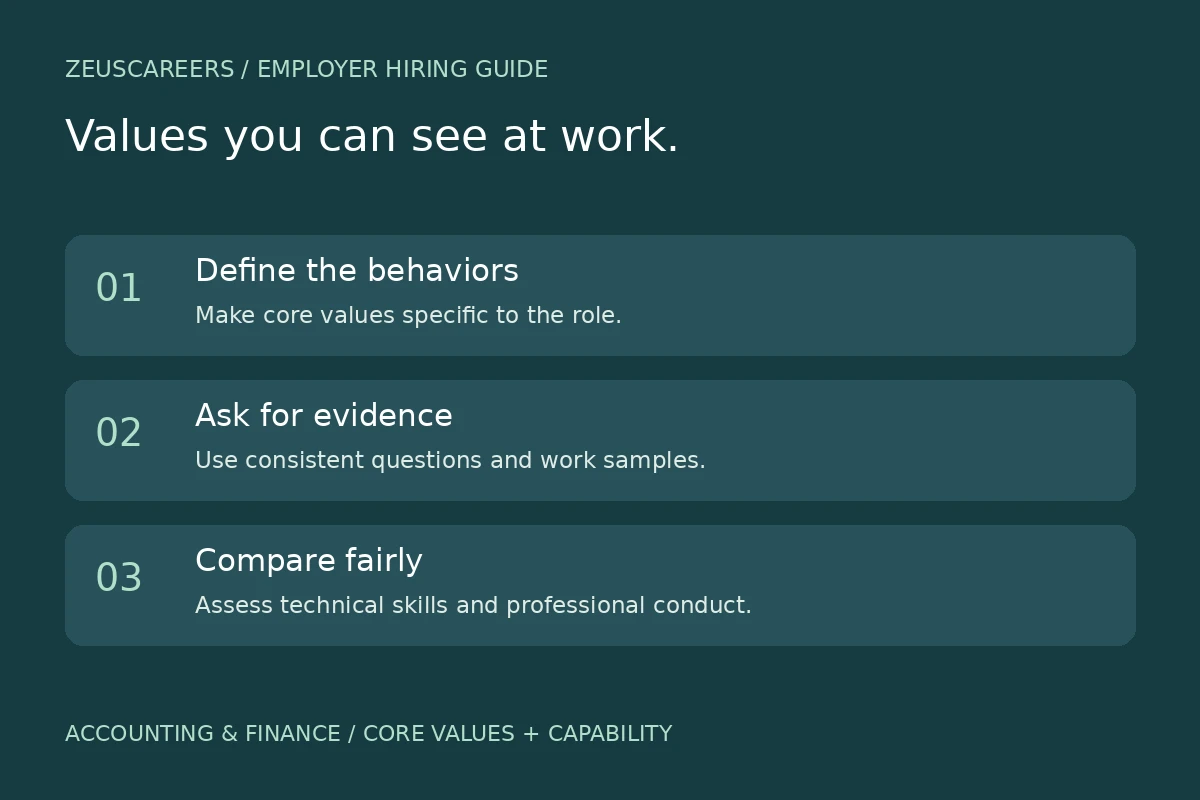
Choose three or four values that matter to success in the position. Define what each looks like during real work. This gives candidates a clearer picture and helps interviewers ask useful questions.
- Integrity: identifies a reporting error, explains its impact, and follows the appropriate review and correction process.
- Accountability: communicates a deadline risk early, takes responsibility for assigned work, and follows through on agreed actions.
- Collaboration: resolves an invoice or budget discrepancy with colleagues using evidence and respectful questions.
- Continuous improvement: suggests a practical process change, checks the result, and preserves necessary controls.
Values alignment should allow different perspectives and communication styles. Similar hobbies, social ease, or a familiar career background do not demonstrate professional integrity or technical competence. Assess the behaviors needed for the work.
2. Define the professional standards for the specific role
“Meets industry standards” needs a concrete definition. Create separate lists for essential capabilities, preferred experience, and skills that can be learned with support. A staff accountant, payroll specialist, and controller should not all face the same checklist.
For an accounting role, you might assess reconciliation quality, supporting documentation, journal-entry review, and close responsibilities. For FP&A, consider forecast assumptions, data validation, variance explanations, and communication with business leaders. For a controller, clarify reporting ownership, controls, team leadership, and audit coordination.
Identify the reporting framework, systems, credentials, and sector knowledge actually required by your organization. Check relevant qualifications when the role requires them. Do not treat a job title or credential as proof of every capability.
Professional ethics also provide context. The AICPA's professional responsibilities guidance describes obligations for its members including integrity, objectivity, competence, due care, and confidentiality. Translate the relevant expectations into your role's responsibilities, while recognizing that professional requirements depend on the position and applicable membership or credentials.
3. Write a job posting that shows your values in practice
Replace broad claims such as “we are a family” or “must fit our fast-paced culture” with details candidates can evaluate. Explain the work, how the team makes decisions, and what support a new hire will receive.
Example: “Our accounting team values accuracy, early communication, and shared problem solving. You will own assigned balance-sheet reconciliations, flag unresolved differences before close deadlines, and work with operations to document root causes. Your manager reviews complex adjustments and supports your development.”
Include the reporting line, work arrangement, compensation information where available, typical deadlines, and the systems used. Describe demanding periods honestly. Make clear which qualifications are essential and which are preferred.
When the scope is ready, post your accounting or finance job free on ZeusCareers. Employers managing multiple openings can explore the XML job feed service to discuss connecting their job inventory.
4. Attract candidates through a clear employer story
Your posting, employer website, recruiter conversations, and interview process should tell a consistent story. If you value development, describe how employees receive feedback and build skills. If you value accountability, explain how responsibilities and escalation paths are defined.
- Share realistic examples of team collaboration and process improvement.
- Use relevant accounting and finance job titles so candidates can find the opening.
- Invite employee referrals while continuing to consider applicants from other sources.
- Give candidates clear next steps, interview expectations, and timely updates.
- Explain how leaders handle mistakes and questions, including during deadline pressure.
Use specialist job boards, professional networks, and recruiting support to reach relevant talent. For an overview of recruiting support available through the partnership, see ZeusCareers and BestLogic Staffing.
5. Use structured interview questions
The U.S. Office of Personnel Management describes structured interviews as using predetermined questions and common scoring standards. Apply that principle by choosing job-related questions and rating criteria before interviews begin.
Use the same core questions for candidates applying to the same role, with consistent follow-up prompts to clarify their individual contribution, actions, and results.
- Integrity: “Tell us about a time you found an error in a report or account. How did you verify it, communicate it, and help resolve it?”
- Accountability: “Describe a deadline you were at risk of missing. When did you raise the issue, and what happened next?”
- Collaboration: “Give an example of resolving a disagreement with another department over financial information. What evidence did you use?”
- Judgment: “What would you do if you were asked to approve an adjustment without enough supporting documentation?”
- Improvement: “Describe a process you improved. How did you check accuracy and maintain review controls?”
Listen for specific actions rather than polished statements about being a team player. Ask candidates to avoid confidential information. Early-career applicants may use relevant internship, academic, or other work examples when those demonstrate the same competency.
6. Assess technical skills with a relevant work sample
A short exercise can make the technical discussion more concrete. Use fictional or sanitized data, explain the task, and set a reasonable time limit. Give candidates for the same role comparable materials and assess against predefined criteria.
For a staff accountant, provide a small reconciliation with several differences. Ask the candidate to identify what they can resolve, what evidence is missing, and which items need review. For a financial analyst, provide budget and actual data and ask for a brief variance explanation that distinguishes facts from assumptions.
Review both the answer and the reasoning. A candidate who clearly identifies missing information gives you useful evidence about judgment. Do not turn an exercise into unpaid production work, and explain how candidates can request an adjustment to the assessment process.
7. Compare evidence with a hiring scorecard
Use the following as a starting template. Define the expected level for your vacancy before assessing applicants, and record an example supporting each rating.
| Criterion | Evidence to collect | Example of a strong response |
|---|---|---|
| Technical capability | Role-specific exercise and experience | Accurate work, clear method, and appropriate review points |
| Integrity and judgment | Error or documentation scenario | Verifies facts, raises concerns, and follows the review process |
| Accountability | Deadline example | Communicates risk early and owns follow-through |
| Collaboration | Cross-functional example | Uses evidence and handles disagreement respectfully |
| Learning and improvement | Process-change example | Checks results and maintains necessary controls |
A simple scale might use 1 for evidence below the required level, 2 for partial evidence, 3 for meeting the requirement, and 4 for strong evidence beyond it. Mark “not assessed” separately so missing information prompts a follow-up. Set role-specific examples for each level. Have interviewers record ratings independently before discussing them.
Keep essential technical requirements visible. An overall average should not conceal a missing requirement or unresolved evidence. Compare notes with your accounting and finance interview scorecard process.
8. Let candidates assess your culture too
Values alignment is a two-way decision. Give candidates time to ask how feedback works, how close deadlines are managed, and how managers respond to errors. Explain the team's current challenges and the support available during onboarding.
Where references are part of your process, follow your established consent procedure and ask consistent, job-related questions. After hiring, reinforce the same expectations through clear responsibilities, onboarding, and regular feedback.
Frequently asked questions
How do you assess culture fit in accounting recruitment?
Define the work behaviors associated with your core values, ask structured questions, and record specific evidence. Evaluate professional conduct and collaboration alongside the technical requirements of the role.
Can values alignment replace industry experience?
Assess them separately. Some roles require specific experience from the start; others can support learning. Decide what is essential before interviewing and make the development plan realistic.
How can employers attract candidates who share their values?
Describe values through everyday work, explain expectations clearly, and demonstrate those behaviors throughout the hiring process. Give candidates enough information to decide whether the environment suits them.
Build a stronger accounting and finance hiring process
Define the role, make your values observable, and compare candidates using consistent evidence. Post a job on ZeusCareers, explore the employer resource hub, or learn about recruiting support through BestLogic Staffing.
Put your next move into action.
Explore accounting and finance opportunities, strengthen your resume, or find practical hiring tools.