
How to Become a Budget Analyst: Skills, Duties, and Interview Tips
Explore budget analyst careers, budget-to-actual reporting, useful skills, interview questions, and ways to prepare for your next finance job application.
In this article
When department spending differs from plan, a budget analyst helps explain the movement and what it may mean for the rest of the year. The role combines financial reporting, careful questions, and collaboration with people who manage operations. It can appeal to candidates who enjoy working with numbers and explaining the business activity behind them.
This guide introduces budget analyst duties, a practical variance example, and ways to prepare for an application. Responsibilities vary by employer, so compare each opening with the work you want to do.
What does a budget analyst do?
A budget analyst supports the preparation, monitoring, and review of financial plans. Some roles concentrate on departmental expenses, while others include staffing plans, capital spending, revenue assumptions, or program funding. Public-sector and private-sector jobs can involve different processes and terminology.
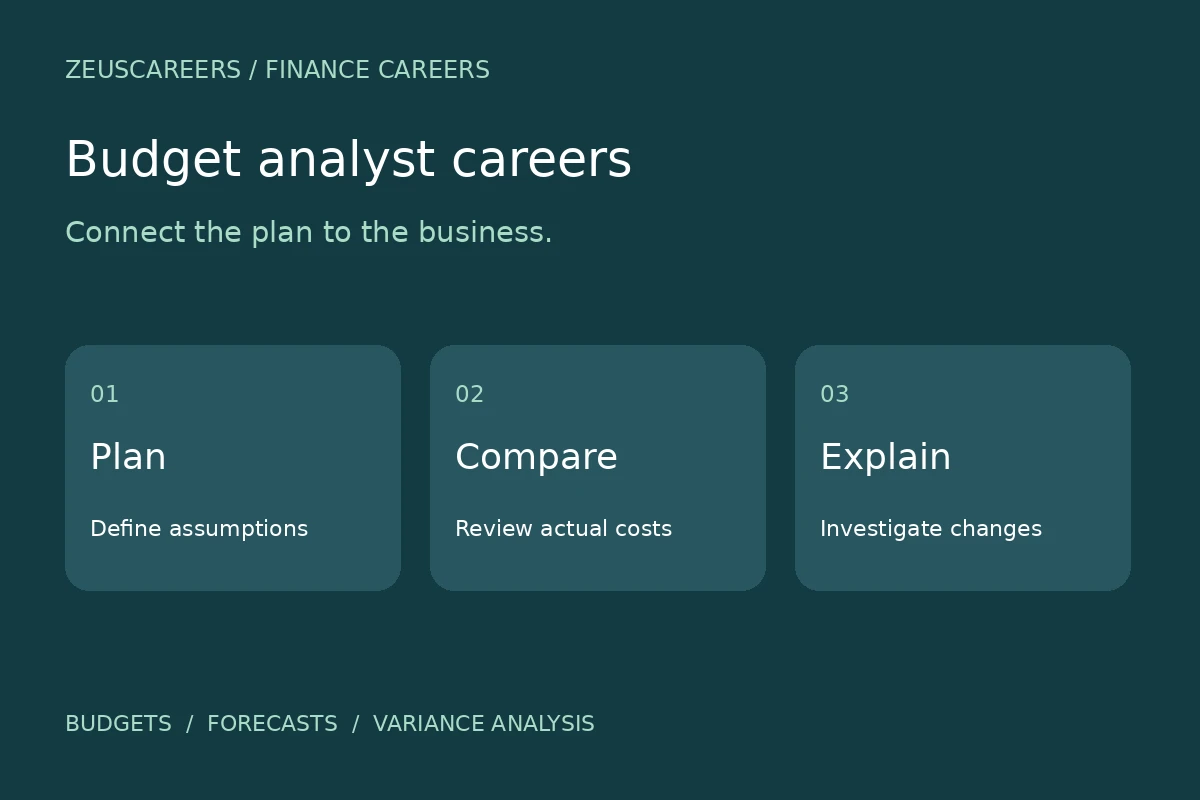
- Gather planning inputs. Collect assumptions and proposed spending from department owners, checking that the period and scope are clear.
- Review actual results. Compare recorded activity with the approved budget and identify significant movements.
- Investigate differences. Ask whether a variance reflects timing, a price change, a different volume of activity, or an error.
- Support forecasts. Help update expectations for remaining periods using documented assumptions and current information.
- Explain results. Prepare summaries that show the movement, the evidence, and questions requiring a decision.
Budget vs. forecast vs. actual results
The budget is the financial plan approved for a defined period. A forecast updates the expected result using information available at a later date. Actual results reflect activity recorded for the reporting period. Keep these versions separate so readers can see both the original plan and the latest expectation.
When comparing reports, confirm the department, account scope, reporting date, and whether the figures include adjustments. A different budget version or incomplete month of actual results can create a misleading comparison.
A simple budget-to-actual example
Assume a fictional department budgets $20,000 for a month's training costs and records $24,000 of actual expense. The expense variance is $4,000 above budget, or 20% of the $20,000 budget. The calculation is ($24,000 minus $20,000) divided by $20,000.
The next step is investigation. Suppose $3,000 relates to a training session planned for the following month and $1,000 reflects additional attendees. Confirm the dates, invoices, and remaining schedule before concluding how much the full-year outlook changes. If the earlier session replaces next month's planned session, the timing difference may reverse. If it is an extra session, the forecast needs to reflect that.
Explain the cause with supporting records. An above-budget expense alone does not tell the reader whether the activity was approved, necessary, or expected to continue.
Skills to demonstrate in a budget analyst application
Spreadsheet analysis. Show how you organize data, compare versions, use lookups or pivot tables, and reconcile totals. Describe how you catch missing rows, duplicate records, or inconsistent account categories.
Financial understanding. Be prepared to explain expenses, revenue, cost centers, and the difference between cash timing and recorded activity at the level required by the job. Connect your explanation to work you have actually performed.
Assumption management. Document inputs such as staffing levels, contract renewal dates, or expected activity. Make it clear which inputs are confirmed and which still need review.
Communication. Practice asking a department manager a specific question about a movement. A useful prompt might be, “Does this month's increase reflect additional activity, or spending that moved from another period?”
Build a practice budget report
- Create a fictional department with six expense categories and three months of budget and actual data.
- Calculate dollar variances and percentage variances where the budget is nonzero. Flag zero-budget items separately for investigation.
- Add notes explaining two timing differences and one recurring cost change.
- Prepare a revised forecast with assumptions shown alongside the numbers.
- Write a short summary of the largest movements and the information still needed.
Label the exercise as a practice project if you share it with employers. It gives you a concrete way to discuss your method, checks, and communication even if your previous title was outside financial analysis.
Prepare for budget analyst interview questions
- How do you investigate a large variance? Start with data completeness and report scope, then trace the movement to transactions and business activity.
- What would you do when a department submits an unsupported assumption? Clarify the basis, request evidence, and document the review needed before including it in the plan.
- How would you explain a forecast change to a manager? State what changed, quantify the movement, identify the supporting assumptions, and explain what needs attention.
- How do you manage competing planning deadlines? Use an example showing how you tracked dependencies, followed up on missing inputs, and raised risks early.
Ask the employer who owns the budget, how often forecasts change, which systems are used, and how the analyst works with department leaders. Those details help you understand whether the position emphasizes reporting, planning, or broader analysis.
How to find budget analyst jobs
Search budget analyst, budget coordinator, financial analyst, and planning analyst. Read each description because similar titles can cover different work. Compare requirements for education, systems, sector experience, and any credentials or eligibility conditions listed by the employer.
If you come from accounting, highlight reconciliations and management reporting. If you come from operations, describe experience tracking spending and explaining activity changes. Use accurate examples of your own contribution and identify skills you still need to build.
Explore budget analyst opportunities on ZeusCareers and the FP&A career path guide. For your application, use the accounting and finance resume writing tips and candidate resource hub.
Frequently asked questions
Is a budget analyst the same as a financial analyst?
The duties can overlap. Budget analyst roles typically emphasize planning and monitoring budgets, while financial analyst positions may also cover investment analysis, commercial reporting, or other responsibilities. Compare the work listed in each vacancy.
Can accounting experience help with budget analysis?
Account reconciliations, close support, and reporting can provide relevant foundations. Build examples showing how you explain differences, document assumptions, and communicate with budget owners.
Do I need advanced modeling skills to apply?
Check the specific vacancy. Some positions focus on reliable reporting and spreadsheet analysis, while others require more complex modeling. Explain the tools and methods you can use confidently.
Put your next move into action.
Explore accounting and finance opportunities, strengthen your resume, or find practical hiring tools.