
How to Become a Project Accountant: Duties, Skills, and Interview Tips
Explore project accountant careers, including job duties, project budgets, cost tracking, useful skills, interview questions, and job search tips.
In this article
- What does a project accountant do?
- Project accounting vs. general ledger accounting
- Understand budgets, actual costs, commitments, and forecasts
- Skills to build for project accountant jobs
- Build a practice project before applying
- Prepare for project accountant interview questions
- How to find project accountant opportunities
- Frequently asked questions
A project can appear on budget today and still face a cost overrun before completion. Invoices may be waiting for approval, purchase orders may cover work that has yet to be delivered, or the scope may have changed. A project accountant helps the team connect those details to the project's financial records.
If you enjoy accounting and working with people who manage delivery, project accounting is a career path to explore. This guide explains common responsibilities, a practical budget example, and ways to prepare for project accountant jobs.
What does a project accountant do?
A project accountant tracks financial activity for individual projects. Depending on the employer, the position may involve cost coding, billing support, budget reporting, reconciliations, and project closeout. Engineering firms, construction companies, professional services businesses, and other organizations that deliver work by project may organize accounting responsibilities this way.
- Review project setup. Check project identifiers, approved budgets, billing details, and the people responsible for reviewing financial activity.
- Track project costs. Review labor charges, supplier invoices, expenses, and other transactions assigned to the project.
- Support billing. Gather supporting documents and confirm that proposed invoices follow the agreed billing process.
- Prepare reports. Compare recorded costs with budgets and help explain changes in the expected cost of completing the work.
- Reconcile and close. Investigate differences, resolve open items with the appropriate owner, and maintain records for review.
Read each job description carefully. Some project accountant positions emphasize customer billing and time records. Others focus on job costing, vendor activity, and financial reporting.
Project accounting vs. general ledger accounting
General ledger accounting brings transactions together into the organization's accounts and reporting periods. Project accounting follows the financial activity of a particular project, which may run across several periods. The two views need to reconcile.
A project accountant may investigate why a supplier invoice appears under the wrong job, while a general ledger accountant may review the related expense account across the business. Both need accurate source documents, appropriate approvals, and a clear audit trail. Our accounting career guide explains broader career options.
Understand budgets, actual costs, commitments, and forecasts
These terms help you read a project report and ask more precise questions.
- Approved budget. The authorized financial plan for the project. Confirm whether a report shows the original budget or a revised approved version.
- Actual costs. Costs recorded to the project as of the reporting date. Check the period and transaction status included in the report.
- Open commitments. Remaining obligations such as undelivered portions of purchase orders, according to the company's reporting definitions.
- Estimate to complete. The expected cost of the remaining work. Confirm whether it already includes open commitments.
- Forecast total cost. Recorded costs plus the expected remaining cost, using a consistent definition that avoids counting the same obligation twice.
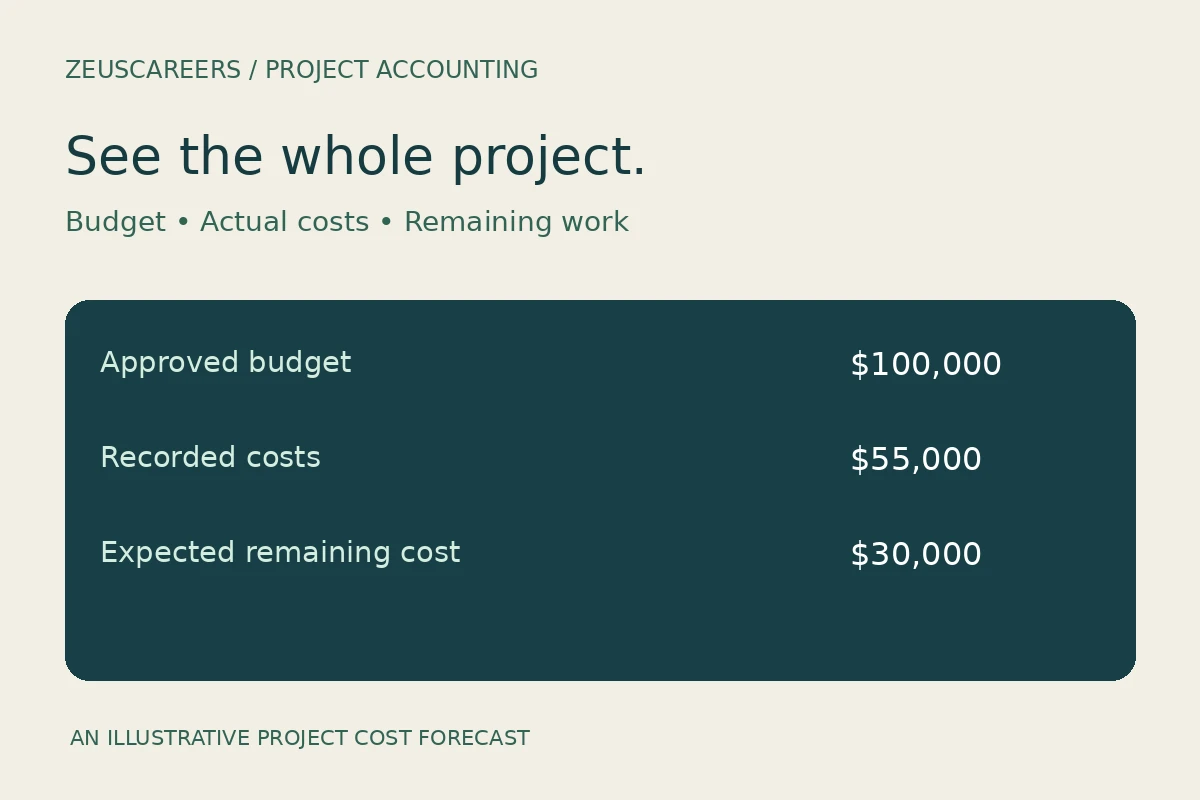
For a fictional example, assume a project has an approved cost budget of $100,000. It has $55,000 of recorded costs, $20,000 of open commitments, and $30,000 of expected remaining cost. The project manager confirms that the $30,000 already includes the $20,000 of commitments. The forecast total is therefore $85,000, with $15,000 remaining against budget.
The accountant should verify whether the forecast includes all remaining work, check for invoices awaiting entry, and confirm that scope changes have been considered. The $15,000 is a forecast budget difference. It does not establish the project's profit or cash position.
Skills to build for project accountant jobs
Cost coding and reconciliation. Practice tracing a transaction to its invoice, time entry, or expense record. Explain how you investigate an incorrect project code and document an approved correction.
Spreadsheet and reporting skills. Be able to compare transaction lists, identify duplicate entries, summarize costs by category, and reconcile totals. Explain how you check that the data covers the correct period.
Systems knowledge. Describe the ERP, timekeeping, expense, or project management systems you have used. Be specific about your work in those systems, such as preparing reports or reviewing invoices.
Communication. Project managers may need to explain the work still to be delivered before an accountant can understand a variance. Practice asking clear questions about scope, approvals, timing, and the next action.
Close discipline. Show how you organize deadlines, maintain supporting schedules, and flag incomplete information for review. These skills also connect with the topics in our month-end close interview guide.
Build a practice project before applying
Create a fictional project with an approved budget, several supplier invoices, employee time records, and a small list of open purchase orders. Keep all the data synthetic.
- Assign transactions to project cost categories and summarize actual costs.
- Compare your summary with a separate control total and investigate differences.
- Add a forecast for the remaining work and state whether commitments are included.
- Write a short report explaining the largest budget movement and two questions you would ask the project manager.
Label this as a practice project when discussing it with an employer. It can demonstrate your method and questions, especially when you are moving from billing, accounts payable, accounts receivable, or a junior accounting role.
Prepare for project accountant interview questions
- How would you investigate a cost posted to the wrong project? Explain how you verify source records, check the correct project and period, obtain the required approval, and confirm the correction.
- A project manager says the job is on budget, but your forecast shows an overrun. What would you do? Compare the budget version, actual costs, commitments, remaining scope, and assumptions before deciding what explains the difference.
- A customer invoice is ready, but supporting documents are missing. How do you proceed? Identify the missing evidence, confirm the billing requirements, and coordinate with the responsible owner and reviewer.
- How do you manage several project deadlines? Give a real example showing how you tracked priorities, communicated dependencies, and raised a delay early.
Ask the employer how many projects you would support, how often forecasts are updated, who owns billing approvals, and which systems connect project reports to the ledger. Those details help you evaluate the actual scope.
How to find project accountant opportunities
Search for project accountant, project accounting analyst, project billing specialist, and job cost accountant. Read the duties to distinguish billing-focused positions from roles with broader cost and reporting ownership. Requirements vary by employer and project environment.
On your resume, describe relevant work with transaction reviews, reconciliations, billing support, or department reporting. Add accurate details about scope and frequency. For example, a candidate with matching experience could write, “Reviewed supplier invoices against project codes and approvals, resolving discrepancies with project managers before month-end review.”
Browse project accountant opportunities on ZeusCareers, explore the candidate resource hub, and use our accounting and finance resume tips to prepare your application.
Frequently asked questions
Can accounts payable experience help me move into project accounting?
Invoice review, purchase order matching, cost coding, and resolving discrepancies can provide relevant experience. Compare the vacancy with your background and identify gaps in project reporting, billing, or forecasting.
Is a project accountant the same as a project manager?
The roles work together. The accountant supports financial records and reporting, while the project manager coordinates delivery and contributes information about scope, progress, and remaining work. Responsibilities depend on the organization.
What career paths can follow project accounting?
Depending on your experience, you may explore senior project accounting, project finance, cost accounting, or accounting management roles. Look at the responsibilities you would need to develop for the specific next position.
Put your next move into action.
Explore accounting and finance opportunities, strengthen your resume, or find practical hiring tools.