
The True Cost of an Unfilled Accountant Position: What Every Company Should Calculate
Calculate the cost of an unfilled accountant position using coverage costs, management time, delayed work, recruiting expenses, and avoided compensation.
In this article
- Start with the vacancy period and the work affected
- Calculate additional coverage costs
- Value the management time redirected to the role
- Measure backlog, rework, and delayed decisions
- Include recruiting costs and account for avoided compensation
- A worked six-week accountant vacancy example
- Compare hiring options using the same assumptions
- A checklist for your accountant vacancy calculation
- Frequently asked questions
- Reach accounting and finance candidates through ZeusCareers
An open accountant position affects more than the recruiting budget. Someone still has to reconcile accounts, prepare reporting, answer questions, and support the close. Those responsibilities may shift to managers, create extra coverage costs, or wait in a growing backlog.
To calculate the cost of an unfilled accountant position, start with the work that needs coverage and the financial impact you can document. Use your own payroll, contractor invoices, close schedules, and recruiting records. A clear estimate helps finance and hiring leaders compare the cost of waiting with the cost of filling the role.
Start with the vacancy period and the work affected
Choose a defined period, such as the six weeks since the employee left. Then list the responsibilities affected. A staff accountant vacancy may disrupt reconciliations and journal-entry preparation. A senior accountant vacancy may create gaps in review, reporting, or audit support. A controller vacancy can shift oversight and decisions to the CFO or other leaders.
Record which tasks received coverage, which were postponed, and who now owns them. Identify an internal source for each estimate so someone else can reproduce the calculation.
Calculate additional coverage costs
Include cash spending caused by the vacancy. Examples include additional paid overtime, temporary accounting support, contractor charges, and extra outsourced work. Use the actual amount for the period being reviewed.
Separate ordinary spending from incremental charges. If your company already paid an outside firm for a recurring service, include only the additional work attributable to the vacancy. Check whether contractor fees already cover the same hours included in another line of the estimate.
Value the management time redirected to the role
A manager may spend several hours each week preparing reconciliations that the vacant position previously handled. Track those hours and apply a documented internal hourly cost. For example, 20 hours at an assumed loaded hourly cost of $70 represents $1,400 of staff capacity redirected to coverage.
For a salaried employee, that time may produce no additional payroll payment. Present it as an allocation of existing capacity and explain the work displaced. Possible examples include delayed process improvements, less time reviewing forecasts, or slower support for department leaders. Keep the dollar estimate tied to recorded hours and a stated rate.
Measure backlog, rework, and delayed decisions
Use operational measures alongside the dollar total. Track overdue reconciliations, unresolved items, extra review cycles, and the number of days required to complete the close. Compare equivalent periods and account for other changes in workload.
For each issue, identify a specific impact. If a reporting delay required an additional contractor invoice, include that documented charge. If it delayed a management meeting, record the delay and the decision affected. Where a dollar amount is uncertain, describe the impact and the evidence you would need to value it.
A vacancy can also reduce review capacity. Record the controls or deadlines that need attention and assign an owner. Treat potential penalties, errors, or losses as scenarios until there is evidence of an actual cost and a defensible link to the vacancy.
Include recruiting costs and account for avoided compensation
Track job advertising, recruiting fees, and other hiring expenditures when they arise. You can also measure interview and screening hours as internal capacity. Keep time already included under management coverage out of the recruiting-time estimate.
Then calculate compensation avoided during the vacancy using your company's actual payroll and benefit treatment. Include salary, employer payroll costs, and benefits only to the extent those costs were avoided during the period. Some benefit and overhead costs may continue.
A practical model for a defined period is:
Net incremental cash impact = additional coverage spending + other documented vacancy-related cash costs + recruiting cash spending − compensation actually avoided.
Show existing employee capacity redirected to coverage as a separate measure. You may add it to the net cash impact for a broader resource-cost view, provided the assumptions and treatment are explicit and the same hours are counted once.
A worked six-week accountant vacancy example
The figures below are hypothetical planning assumptions for one six-week vacancy. They illustrate the method and should be replaced with your own records.
| Item | Assumption | Amount |
|---|---|---|
| Additional paid overtime | 60 hours × $45 | $2,700 |
| Temporary accounting support | 80 hours × $80 | $6,400 |
| Additional outsourced work | Separate invoice for work outside the temporary assignment | $1,200 |
| Recruiting cash spending | Advertising and other incurred charges | $600 |
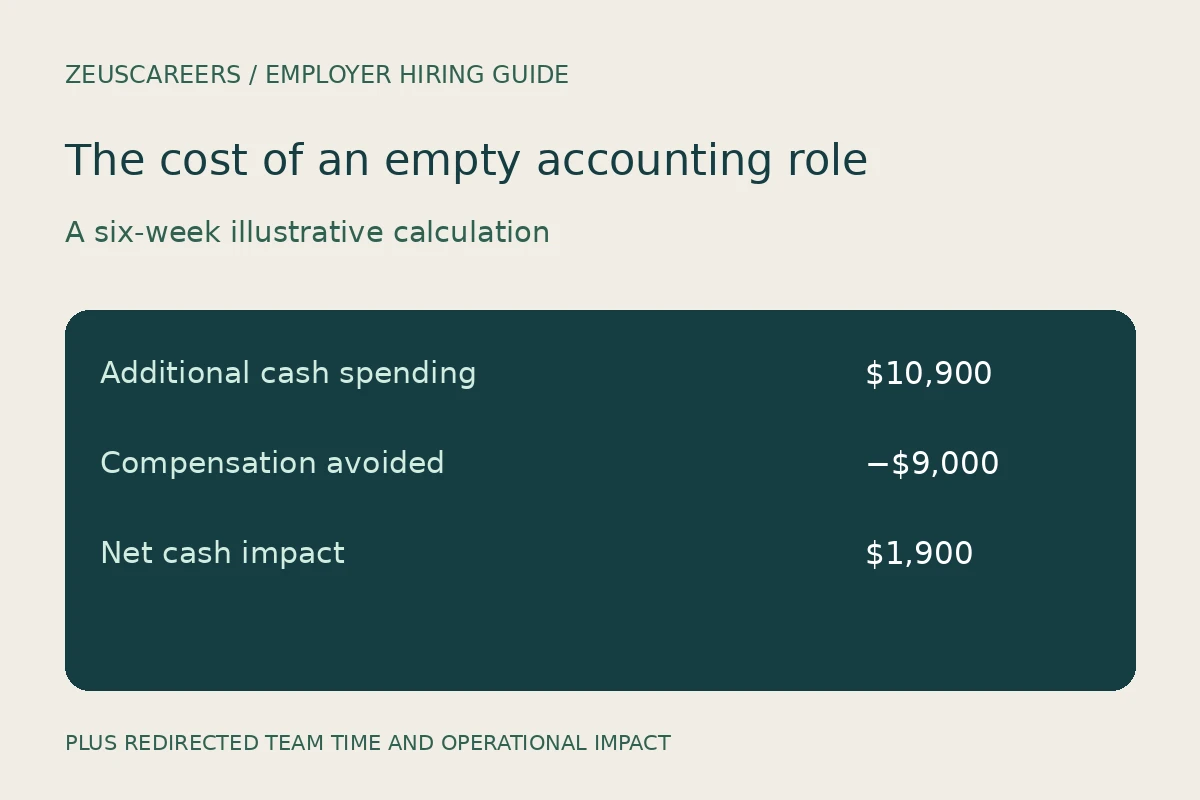
| Total incremental cash spending | Sum of the four rows above | $10,900 |
| Compensation actually avoided | Finance team's documented estimate | −$9,000 |
| Net incremental cash impact | $10,900 − $9,000 | $1,900 |
| Manager capacity redirected | 20 separate hours × $70 | $1,400 |
| Broader resource-cost estimate | $1,900 + $1,400 | $3,300 |
In this example, the cash impact is about $317 per week over six weeks. The broader resource-cost estimate is $550 per week. These averages describe this scenario. For a decision about another month of vacancy, estimate the future coverage plan and future avoided compensation, since the weekly amounts may change.
List any close delays, reconciliation backlog, or control concerns next to the calculation. Keeping those measures visible helps decision-makers see operational consequences that the cash total alone may leave out.
Compare hiring options using the same assumptions
Evaluate a continued vacancy, temporary coverage, and a permanent hire over the same future period. For each option, estimate the compensation, coverage spending, recruiting charges, onboarding time, and work expected to be completed. Account for when the new person can realistically take ownership.
Clarify the role before widening the search. Define the accounts, entities, close responsibilities, systems, review expectations, and required experience. A precise scope helps applicants and interviewers assess the same work. Use our values-based accounting hiring guide and interview scorecard to prepare a consistent assessment.
A checklist for your accountant vacancy calculation
- Define the vacancy period and the responsibilities affected.
- Gather incremental overtime, temporary support, and outsourced charges.
- Record management and team coverage hours with their assumptions.
- Track close timing, unresolved reconciliations, and review capacity.
- Include recruiting costs and compensation actually avoided.
- Check for overlapping hours, invoices, and cost categories.
- Compare forward-looking hiring options over the same period.
Frequently asked questions
How much does an unfilled accountant position cost?
The amount depends on the coverage plan, vacancy duration, work delayed, and compensation avoided. Calculate your company's incremental cash impact and show redirected employee capacity and operational measures alongside it.
Should we count the full salary as the cost of vacancy?
Start with the actual costs caused by the vacancy and the compensation avoided. The vacant role's salary can help estimate avoided payroll, while additional coverage spending and displaced work show the consequences of keeping the position open.
How often should we update the calculation?
Update it when coverage costs, the backlog, the expected hiring date, or the role's responsibilities change. During an active search, a weekly review can help the hiring and finance teams work from the same assumptions.
Reach accounting and finance candidates through ZeusCareers
ZeusCareers connects employers and candidates through an accounting and finance job board. Post an accounting job for free or explore the XML job feed service for multiple openings. Visit the employer resource hub for hiring tools, or learn about BestLogic Staffing recruiting support.
Put your next move into action.
Explore accounting and finance opportunities, strengthen your resume, or find practical hiring tools.