
Year-End Accounting Job Search Checklist: Prepare for Your Next Role
Plan your next accounting career move with a year-end job search checklist covering resume achievements, target roles, interview preparation, and offer questions.
In this article
- 1. Define the accounting role you want next
- 2. Build an achievement record before rewriting your resume
- 3. Tailor your accounting resume to the target position
- 4. Prepare interview examples from your recent work
- 5. Organize applications around your close calendar
- 6. Ask questions that reveal the real scope of an offer
- Your year-end accounting job search checklist
A busy close calendar can push your accounting job search to the bottom of the list. A short, structured plan helps you prepare for your next move while keeping your current responsibilities organized. Whether you want a staff accountant position, a senior accountant promotion, or a move into financial analysis, the most useful starting point is a clear record of your experience.
Use this year-end accounting job search checklist to turn your recent work into a focused resume, a realistic target list, and specific interview examples. You can work through it over several weeks and adjust the pace around your reporting deadlines.
1. Define the accounting role you want next
Write down your target job titles, the work you want to own, and the conditions you need to do it well. A title alone rarely explains the scope of a position. One senior accountant role may concentrate on reconciliations and journal entries, while another includes consolidations, audit support, and mentoring junior colleagues.
- Responsibilities: Which tasks do you want to continue, deepen, or add?
- Environment: Consider company size, industry, reporting structure, and the complexity of the entities you would support.
- Practical requirements: Record your location, work arrangement, travel availability, and compensation expectations.
- Development: Identify the experience you need for your longer-term goal, such as supervising a close or supporting budgeting.
Compare several current job descriptions and highlight recurring requirements. Separate skills you can demonstrate today from those you need to build. For progression into leadership, read our guide to moving from senior accountant to accounting manager.
2. Build an achievement record before rewriting your resume
Start with the work you completed during the year. List the problem, your contribution, and the result for each example. Include reconciliations, reporting improvements, audit preparation, spreadsheet controls, and collaboration with operations or other departments.
Use numbers only when you can support them and are permitted to share them. When a result was a team effort, describe your own contribution. Keep client names, employee information, internal reports, and confidential financial details out of your job search materials.
For example, “Responsible for reconciliations” can become “Prepared monthly balance sheet reconciliations, investigated unmatched items with accounts payable, and documented outstanding differences for review.” If you can verify a reduction in unresolved items or review time, add that context. A precise description of your work is useful even without a percentage.
Our accountant resume achievement examples offer more ways to describe your experience accurately.
3. Tailor your accounting resume to the target position
Update your resume after you have defined your target role and collected your examples. Put the most relevant experience near the top. For a general ledger position, emphasize reconciliations, journal entries, close responsibilities, and reporting. For a financial analyst position, highlight forecasting, variance analysis, and communication with business partners where those are part of your experience.
- Use clear section headings and consistent dates.
- Name accounting systems and spreadsheet tools you have actually used.
- Describe your level of ownership: prepared, reviewed, approved, or supported.
- Include relevant qualifications with accurate completion or in-progress status.
- Follow the application’s file-format and submission instructions.
Use terminology from the job description when it accurately describes your background. Read the document once for relevance and once for accuracy. Check that your resume and professional profile agree on job titles, dates, and qualifications. For additional help, explore our accounting and finance resume writing tips.
4. Prepare interview examples from your recent work
Choose four or five examples that show how you approach accounting problems. Useful subjects include resolving a reconciliation difference, meeting a reporting deadline, improving a process, handling missing information, and explaining an issue to a colleague outside finance.
For each example, explain the situation, your responsibility, the steps you took, and the outcome. Be ready to describe your checks and review process. If an issue required escalation, explain when you involved your manager and what information you provided.
Practice answering: “What did you do when a balance did not reconcile?” and “How did you manage competing deadlines during close?” Use specific actions and explain what you learned. Review our month-end close interview questions to build a focused practice session.
5. Organize applications around your close calendar
Choose a search routine you can maintain. For example, reserve one session to review relevant openings, one to tailor applications, and one to prepare for conversations. Keep a simple tracker with the employer, role, application date, job description, contact, and next action.
Save a copy of each job description so you can prepare if the listing changes or closes. Share realistic interview availability and discuss potential start dates honestly. Consider your notice obligations and planned commitments when assessing a transition.
Focus your effort on roles with a clear connection to your experience and goals. A brief application note can explain that connection: the responsibilities you have handled, the relevant system or industry experience you bring, and the work you want to take on next.
6. Ask questions that reveal the real scope of an offer
Before deciding on a new position, ask how the accounting team works. Compare the role against the priorities you set at the beginning of your search.
- Which accounts, entities, and reports would I own?
- What does the close calendar look like, and how are responsibilities assigned?
- Who reviews my work, and how is feedback provided?
- Which systems and process changes are planned?
- What would successful performance look like during the first three months?
- How do work hours, benefits, compensation, and work arrangements fit together?
Ask for clarification when the title and responsibilities seem different from what you expected. A detailed conversation can help you assess whether the opportunity provides the experience and support you need.
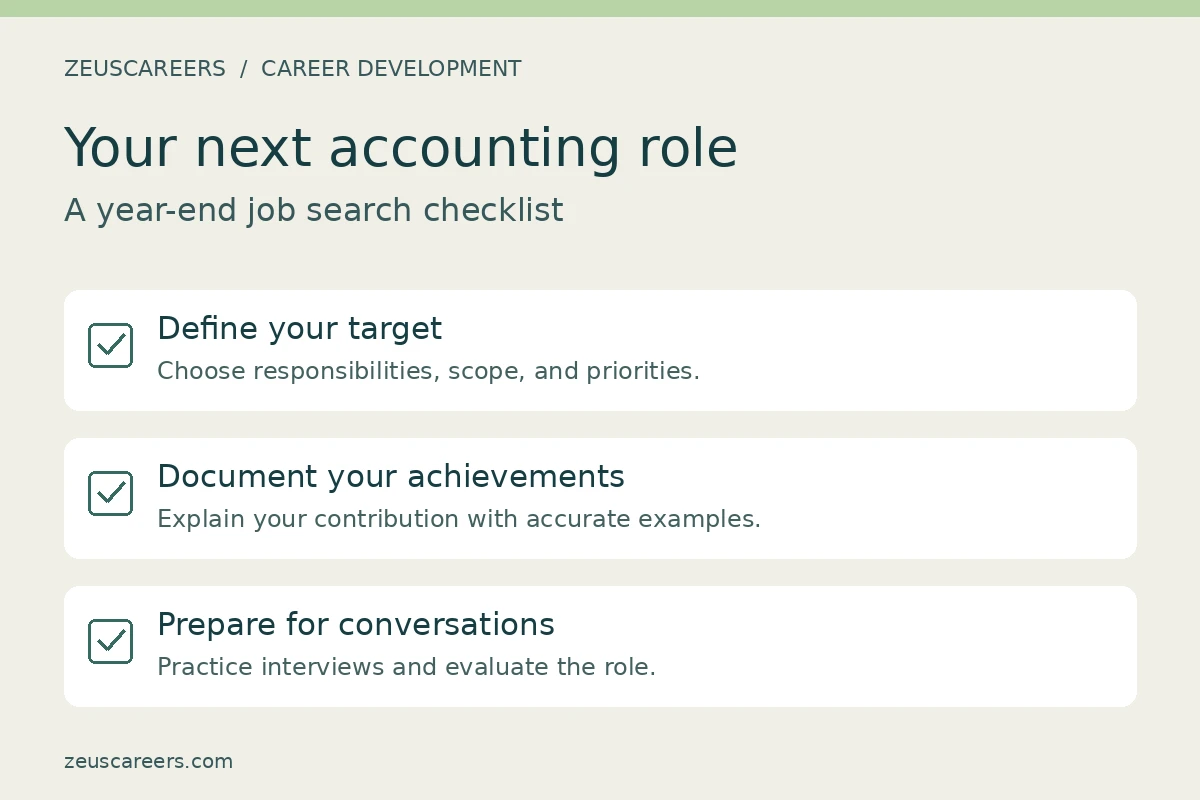
Your year-end accounting job search checklist
- Define your target roles and practical requirements.
- Record recent achievements with accurate, shareable evidence.
- Update your resume and professional profile.
- Prepare specific interview examples.
- Track applications and plan around existing commitments.
- Evaluate opportunities against responsibilities, support, and career goals.
Ready to explore your options? Browse staff accountant jobs, senior accountant jobs, or financial analyst jobs on ZeusCareers. Visit our candidate resource hub for more help preparing your next move.
Put your next move into action.
Explore accounting and finance opportunities, strengthen your resume, or find practical hiring tools.