
How to Become a Fixed Asset Accountant: Duties, Skills, and Interview Tips
Explore fixed asset accountant duties, asset register reconciliations, a worked depreciation example, interview questions, and tips for finding your next accounting job.
In this article
When a company buys equipment, someone has to connect the purchase records to the equipment in use and keep track of what happens to it over time. A fixed asset accountant maintains that connection. The job can suit candidates who enjoy reconciling records and working with teams that purchase, install, and operate equipment.
What does a fixed asset accountant do?
A fixed asset accountant maintains records for long-lived tangible assets such as machinery, vehicles, and buildings. Duties vary by employer, but the work often follows an asset from purchase through disposal.
- Review additions. Compare invoices, purchase orders, and supporting records. Check that the asset description, location, and dates are documented and that the item is reviewed under company policy.
- Maintain the asset register. Track individual assets and update details when equipment moves, changes owners within the business, or leaves service.
- Support depreciation and close. Review the depreciation run for unexpected changes, reconcile the asset register to the general ledger, and document differences for review.
- Track projects in progress. Work with project teams to identify completed installations and obtain evidence of when equipment is ready for use.
- Document disposals. Confirm which asset was sold, retired, or otherwise removed and retain the approvals and records needed for the accounting team.
A simple depreciation example
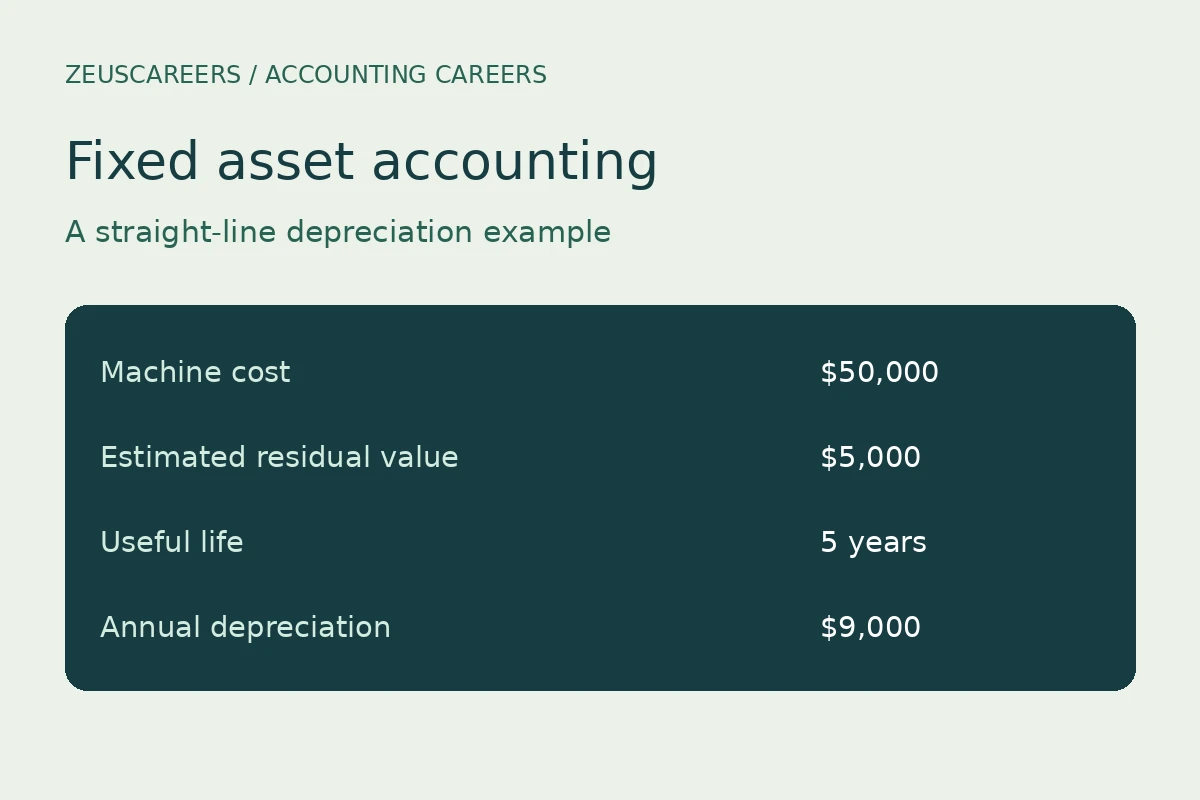
Suppose a fictional company records a machine at a cost of $50,000, estimates a $5,000 residual value, and uses a five-year useful life. Assuming straight-line depreciation and a full year in service, the annual depreciation is $9,000. That comes from spreading the $45,000 depreciable amount evenly over five years. After one full year, the machine’s carrying amount would be $41,000, assuming no other adjustments.
In an interview, explain the assumptions and the checks you would perform. For example, verify the cost against approved supporting records, confirm the in-service date, and compare the register to the ledger. Employers may use different methods or timing conventions depending on their policies and reporting requirements.
Skills to demonstrate when applying
- Reconciliation. Explain how you match a detail report to a ledger balance and trace an unexplained difference to its source.
- Spreadsheet analysis. Show how you match asset IDs, identify missing or duplicate rows, summarize additions and disposals, and check control totals.
- Close and documentation. Describe a schedule you prepared, how you handled exceptions, and how you made the work easy for a reviewer to follow.
- Communication. Show how you would ask procurement, facilities, or operations for missing details about equipment location, installation, or retirement.
If you come from accounts payable, highlight experience checking invoices and matching them to purchase orders. If you come from general ledger or project accounting, describe relevant reconciliations, capital project schedules, or work with cost owners. See the project accountant career guide for a closer look at project cost tracking.
Prepare for fixed asset accountant interview questions
- The asset register and ledger differ. Where would you start? Confirm both reports cover the same date, entity, and accounts. Then compare opening balances and review additions, transfers, disposals, and depreciation to narrow the difference.
- An installation is complete, but the final supplier invoice has not arrived. What information would you gather? Ask for completion and in-service evidence, the approved project scope, costs already recorded, and details about outstanding amounts. Explain how you would bring the facts to the appropriate reviewer.
- Operations says a machine was scrapped, but it still appears in the register. What would you check? Confirm the asset ID, location, retirement date, and disposal approval. Reconcile the documentation to the register before proposing an update.
Ask the employer who owns physical inventory checks, how asset additions reach the accounting team, and what the biggest reconciliation issues are. Those questions help you understand how much of the role involves close work, capital projects, or asset records.
Build a practice asset register
Create five fictional assets with acquisition dates, cost, useful life, and location. Add an in-service date, a transfer, and a disposal. Calculate an illustrative depreciation schedule, then reconcile the opening and closing balances for cost and accumulated depreciation separately. Document one issue you found and how you would resolve it. Label the workbook as a practice project if you discuss it with a hiring manager.
Find fixed asset accountant jobs
Search for fixed asset accountant, fixed assets analyst, capital accountant, and staff accountant roles that list asset responsibilities. Compare postings for close ownership, capital project reporting, systems, and the level of experience expected.
Use your resume to describe what you actually handled. For example, someone with relevant experience might write, “Reconciled asset additions to invoice and purchase order records and investigated missing documentation before close.” Add the volume or scope if you can substantiate it.
Explore fixed asset accountant jobs on ZeusCareers and prepare your application with the accounting and finance resume guide.
Put your next move into action.
Explore accounting and finance opportunities, strengthen your resume, or find practical hiring tools.